
In GRP/composite manufacturing, much of the attention typically focuses on the finished product, strength, surface quality, durability, and lead time.
However, one of the most critical phases of any successful project happens much earlier: design development, pattern creation, and mould manufacture.
These stages are frequently underestimated in planning timelines and budgets, yet they determine long-term production performance.
The Foundation of Repeatability
Unlike metal fabrication, where tooling may be less complex or more adaptable, composite production relies heavily on precision moulds and well-developed patterns.
Poorly considered tooling can result in:
- Surface inconsistencies
- Extended cycle times
- Dimensional variation
- Increased finishing and rework
Conversely, well-engineered patterns and moulds improve:
- Part repeatability
- Surface finish consistency
- Production efficiency
- Long-term cost control
In low-to-medium volume production, common in specialist vehicle components, enclosures, and industrial housings, the quality of the mould directly influences the economics of the entire project lifecycle.
Early Design Decisions Drive Downstream Cost
When GRP/composites are considered late in the design stage, compromises often follow. Wall thickness, fixing strategies, draft angles, and structural reinforcement must align with composite manufacturing principles.
Engaging composite expertise during early design and tooling development allows:
- Optimised structural performance
- Reduced secondary operations
- Fewer tooling modifications
- Shorter route to stable production
In many cases, upfront investment in tooling refinement reduces total project cost significantly over time.
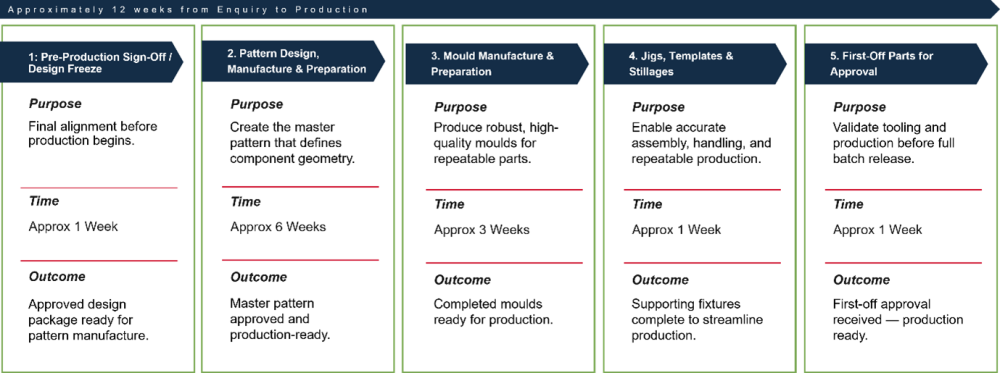
An example of a composite production timeline for a complex project with no existing tooling and assets, showcasing key stage priorities.
Timings vary based on urgency and complexity.
Tooling as a Strategic Asset
Patterns and moulds should not be viewed as a one-off project expense. They are strategic assets that underpin quality and delivery performance for years.
At MPM, our approach integrates design input, pattern development, and mould manufacture into a controlled process before production begins. By resolving complexity at the tooling stage, we reduce variability during manufacture.
For OEMs and manufacturers, this means fewer production headaches and greater confidence in scalability.
A More Informed Approach to Composite Planning
As GRP/composites continue to replace metal and wood in a growing number of applications, understanding the importance of tooling and early-stage planning becomes essential.
Composite success is not just about material selection. It is about process, preparation, and partnership.
By addressing design and tooling properly from the outset, manufacturers protect timelines, budgets, and long-term product performance.
An MPM customer who relies on great quality tooling and moulds