

As we enter 2026, the global shift in material selection among OEMs and manufacturers is becoming unmistakable: GRP/composites are increasingly replacing metal in applications once dominated by steel and aluminium.
This trend reflects both broader market forces and the practical realities faced by manufacturers seeking performance and durability, cost pressures and supply chain resilience. According to industry analysis, the global composites market is projected to grow from approximately USD 93.7 billion in 2022 to nearly USD 164 billion by 2030, at a compound annual growth rate of 7.2%.
Market Momentum Behind Composites
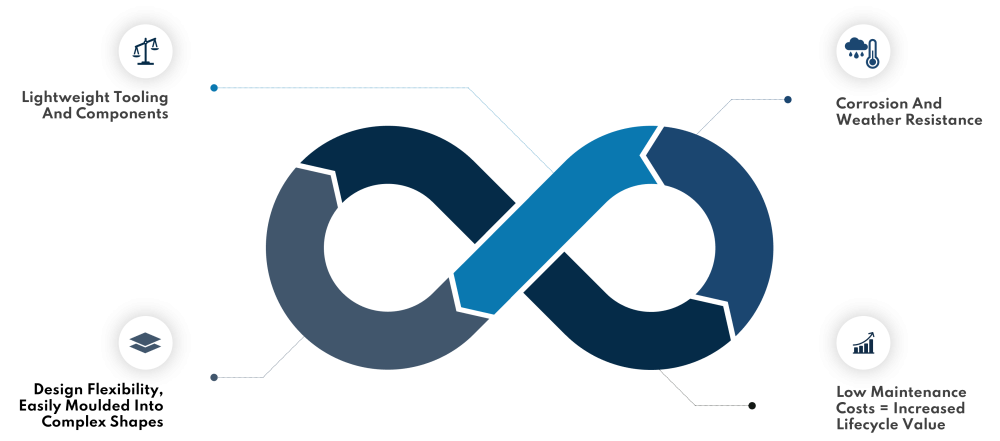
Industry forecasts highlight that GRP/composites are not a niche material class but a rapidly expanding sector. Growth is driven by demand from automotive, aerospace, industrial, construction, and energy sectors that require lightweight, robust materials. This shift is supported by composites’ ability to deliver performance advantages without the weight penalty of metal, and with additional benefits such as corrosion resistance, design flexibility and the tooling and part production stages.
For manufacturers facing cost pressures and sustainability targets, this broader market trajectory reinforces why GRP/composites are now central to product strategies rather than peripheral options.
From Weight Reduction to Performance Integration
Historically, composites were primarily selected for weight reduction, particularly in transport and automotive applications, to improve fuel and battery efficiency. In 2026, the rationale has matured. OEMs and manufacturers now value GRP/composites not only for lower weight, but for the ability to integrate complex functions into single components.
For example:
- Vehicle body panels and modular enclosures, where composite mouldings combine structural support, attachment features, and aesthetic finish without multiple metal parts and joinery
- Industrial electrical and control housings that must withstand corrosive environments without costly protective coatings
- Leisure and marine products where both structural performance and finish quality are critical
These applications demonstrate how composites can eliminate assembly steps and secondary operations, reducing manufacturing variability and lead-time risk. Many products can now serve as a plug-and-play upon delivery style saving time and reducing production complexity for many.
Discover how MPM supports OEMs and manufacturers from concept through to production.
Durability, Corrosion Resistance, and Lifecycle Value
One of the strongest drivers toward GRP/composites is their inherent resistance to corrosion, chemicals, UV exposure, and moisture environments, where metal requires robust protection, inspection, and ongoing maintenance, incurring costs and increasing complexity post-installations.
Products such as:
- Water and chemical storage tanks
- Outdoor electrical enclosures
- Process equipment housings
The above perform exceptionally well with GRP/composites, delivering longer service life with lower lifecycle maintenance cost compared to metal alternatives. This durability translates into lower total cost of ownership, a key metric for operations and procurement leaders.
Design Thinking: Early Material Decisions
Traditionally, composites were considered late in the design cycle once metal solutions encountered performance limits. In contrast, many OEMs and manufacturers are now integrating GRP/composites at the initial design and engineering stage. This early consideration enables:
- Optimised structural performance
- Integrated features
- Reduced tooling changes
- Fewer design iterations
In products where surface quality and durability matter, such as control panels, machine covers, and specialist vehicle components, to name a few, this shift is helping reduce rework and accelerate paths to production.
Simplifying Production and Protecting Core Business
For many manufacturers, the challenge with GRP/composites is not just strategic selection, but also execution. Effective composites production requires expertise in mould design, material selection, process control, and quality assurance.
This is where MPM’s approach is relevant. We partner with OEMs and manufacturers to take the headache out of GRP/composites manufacture and supply, allowing them to focus on their core business operations, product innovation, and growth. Our process, from design support and prototyping through to production and delivery, is engineered to minimise complexity and risk. By absorbing manufacturing challenges, MPM helps clients maintain focus on what they do best, which is often not composite manufacturing.
A Strategic Material Choice for 2026
The global market data and practical experience from across industries confirm a clear trend: GRP/composites are no longer an alternative material reserved for specialist use. They are becoming a strategic choice that supports performance targets, durability expectations, and modern design requirements.
For OEMs and manufacturers evaluating material strategies in 2026 and beyond, composites offer both measurable technical advantages and a compelling market context. Partnering with a capable composites manufacturer can turn ambition into delivery without burdening internal teams with unfamiliar processes or resource constraints.